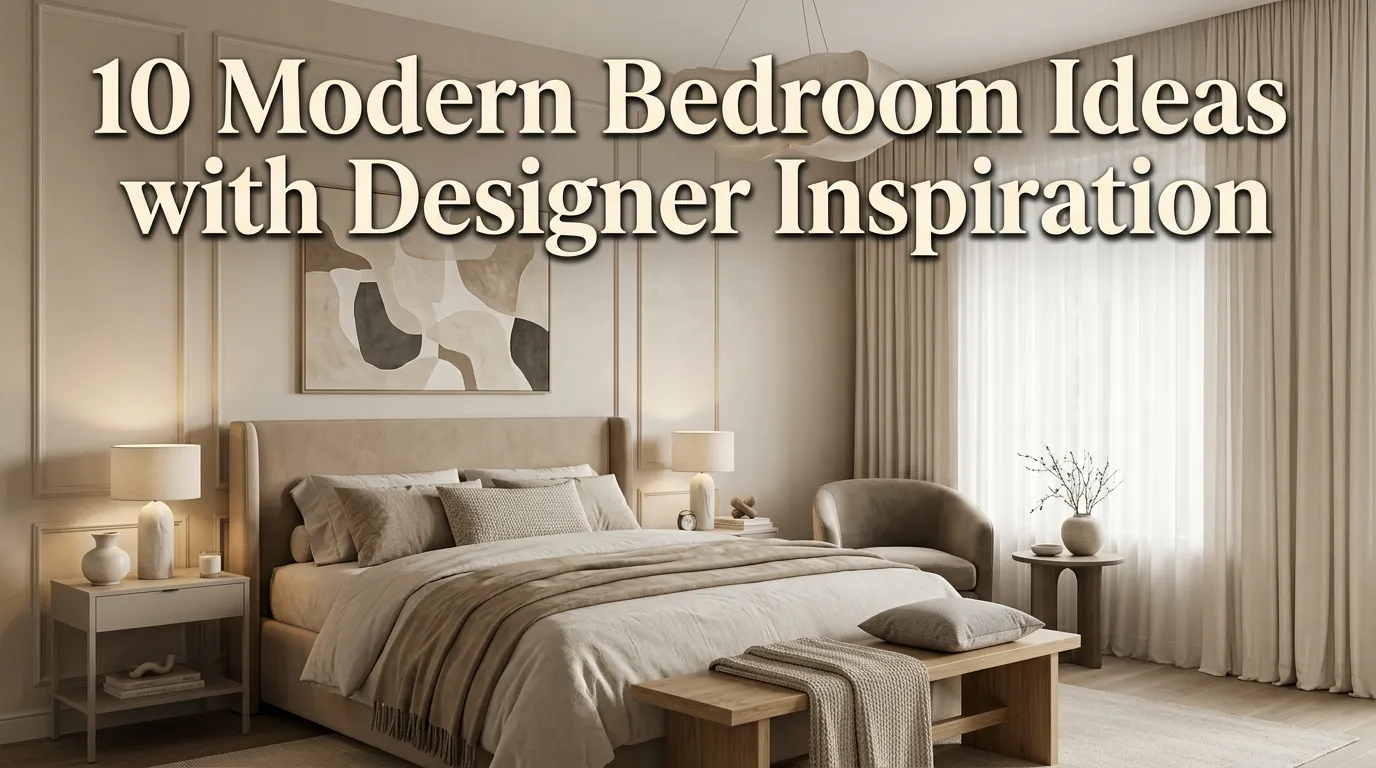
10 Modern Bedroom Ideas with Designer Inspiration
A bedroom should feel like the one room in the house where you can finally exhale. But in my experience, most bedrooms end up as an afterthought — the leftover space after the living room, kitchen, and entryway get all the design attention. If you’ve ever walked into your bedroom at the end of a long day and felt more cluttered than calm, you’re not imagining it. The layout, the lighting, and even the smallest styling choices are working against you instead of for you.
That’s the problem this article is here to solve. Over the years, I’ve noticed that the bedrooms people fall in love with — the ones that actually get pinned, saved, and recreated — share a handful of specific design habits. They aren’t about spending a fortune or gutting the whole room. They’re about intentional choices: the right texture layered at the right moment, lighting that shifts with the time of day, furniture that has a real point of view instead of just filling space.
Modern bedroom design in 2026 has moved away from cold, sterile minimalism and toward something warmer — rooms that feel curated but lived-in, sculptural but comfortable. A mistake many homeowners make is chasing a trend wholesale instead of pulling the individual ideas that actually fit their space and their life.
In this guide, I’m walking you through ten designer-inspired modern bedroom ideas, one at a time, with real styling logic behind each one — not just a photo to admire, but a reason it works and a way to bring it into your own room, whether you’re working with a full renovation budget or a weekend and a trip to the hardware store.
Table of Contents
- Layered Neutral Textures — Building depth in a bedroom without relying on color.
- Statement Headboard Wall — Turning the bed into the room’s visual anchor.
- Warm Ambient Lighting — Replacing harsh overhead light with layered, mood-driven sources.
- Curated Nightstand Vignettes — Styling the small surfaces that get the most daily attention.
- Mixed Metal Accents — Combining finishes for a collected, designer-level look.
- Sculptural Furniture Silhouettes — Choosing shapes that add visual interest without clutter.
- Soft Color Layering — Working with tonal color instead of stark contrast.
- Textured Wall Treatments — Adding dimension to walls beyond a coat of paint.
- Minimalist Gallery Display — Curating art and objects with restraint.
- Cozy Reading Corner — Carving out a small, purposeful nook inside the bedroom.
1. Layered Neutral Textures
Quick Benefits
- Adds visual depth without adding visual noise
- Works with almost any existing color palette
- Feels timeless instead of trend-driven
- Easy to update seasonally with textiles
- Photographs beautifully for a soft, editorial look
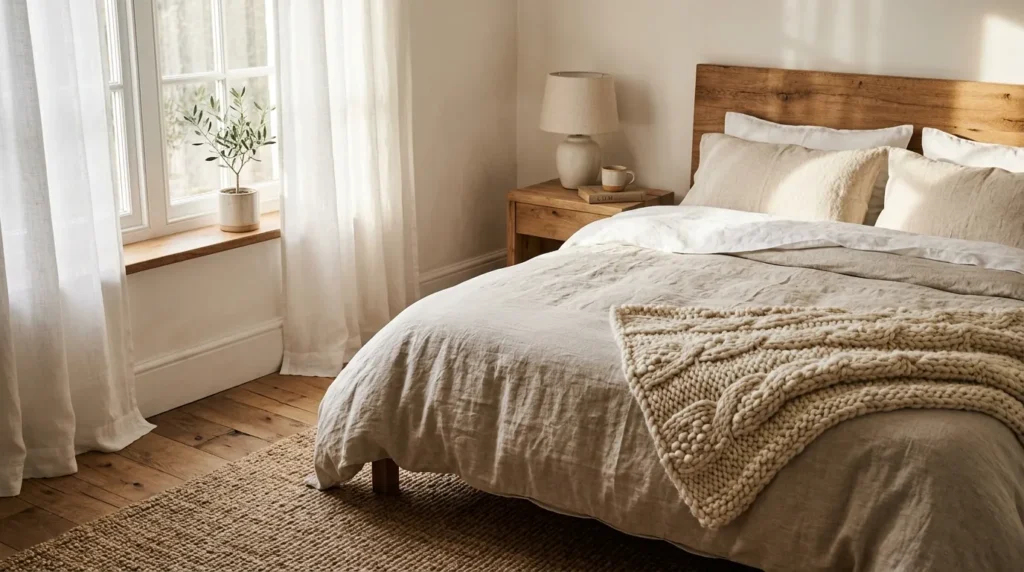
Why It Works A room built entirely from neutral tones can feel flat if every surface has the same texture. In my experience, the bedrooms that feel the most “designed” are the ones layering three or four different textures — a nubby wool throw, a smooth linen duvet, a woven jute rug, a matte ceramic lamp — all in a similar tonal family. This is the trick behind that soft, expensive-looking hotel-suite effect. Your eye reads the contrast in texture even when there’s no contrast in color, which keeps the room feeling calm rather than boring. It’s one of the simplest ways to elevate a space without touching the wall color at all.
How To Style It Start with your bedding as the base layer, then build outward. Try a linen duvet, a bouclé or wool throw folded at the foot of the bed, and a chunky knit or woven rug underneath. Add a rattan or cane bench, a stoneware vase, and at least one raw wood surface — a nightstand or bench works well. Keep the palette within warm whites, oatmeal, taupe, and soft greige so the textures do the talking instead of the color. If you’re anything like me, you’ll want to resist adding a bold accent color here; let this idea breathe on its own first.
2. Statement Headboard Wall
Quick Benefits
- Instantly upgrades the room’s focal point
- Works in small and large bedrooms alike
- Can be achieved at almost any budget
- Adds architectural interest without construction
- Creates a natural backdrop for photos and styling
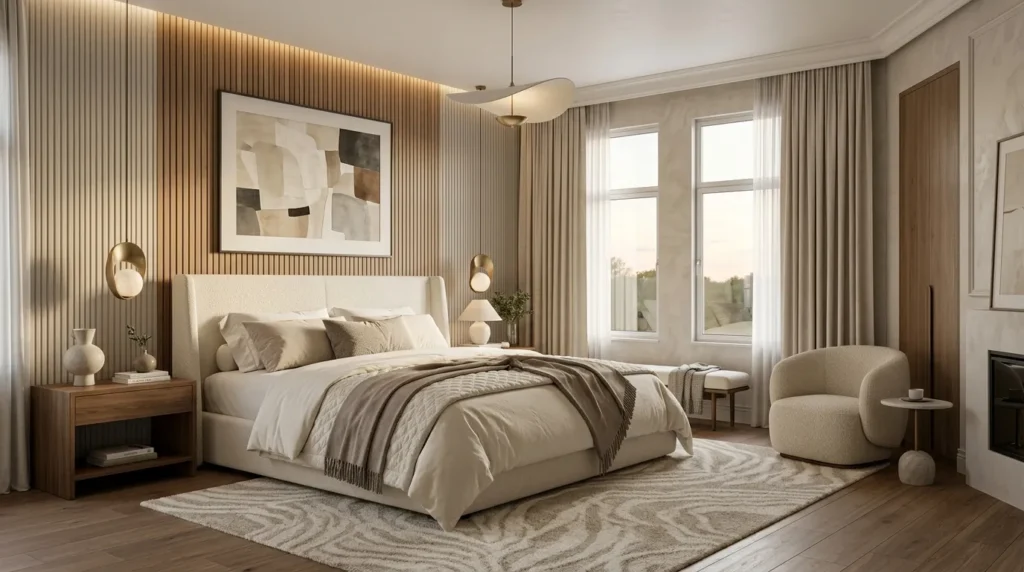
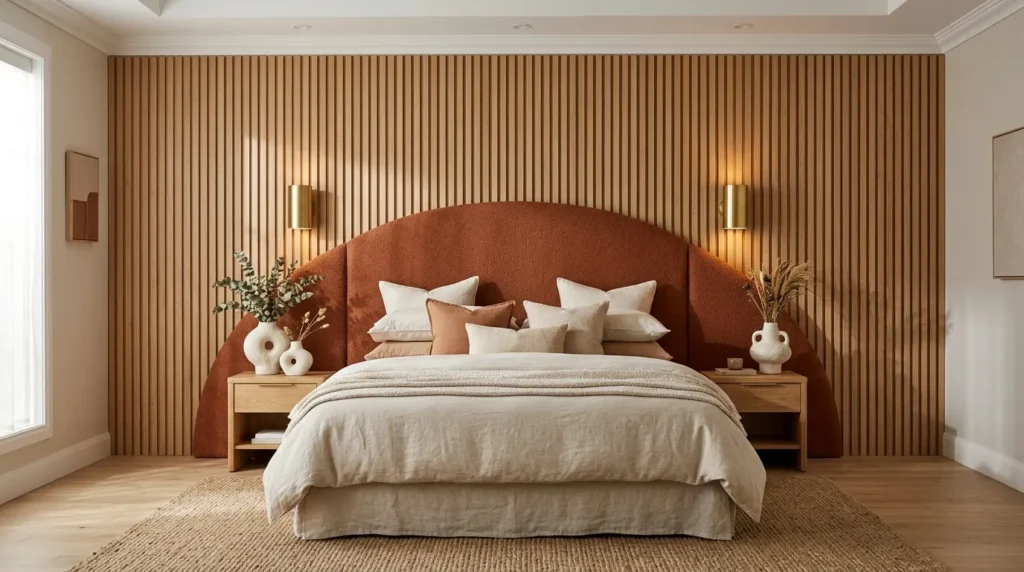
Why It Works The wall behind your bed carries more visual weight than any other surface in the room, yet it’s the one most often left blank. One simple trick I always suggest is treating that wall as its own design moment rather than an afterthought. An upholstered headboard, a wood slat accent wall, or even a bold paint color contained to that single wall gives the eye somewhere to land the moment you walk in. Designers use this technique because it does double duty — it anchors the furniture layout and gives the whole room a sense of intention, even if nothing else in the space has changed.
How To Style It If you’re renting or on a budget, a large fabric panel or a floating wood-slat wall (installed with adhesive strips) can transform the space in an afternoon. If you’re able to renovate, consider board-and-batten trim painted in a warm tone, a curved upholstered headboard, or vertical wood paneling stained walnut or oak. Keep the rest of the walls quieter so this one truly stands out. Flank the bed with matching sconces or pendant lights mounted directly on the statement wall — it reinforces the symmetry and makes the whole setup feel custom-built.
3. Warm Ambient Lighting
Quick Benefits
- Softens the entire mood of the room instantly
- Reduces harsh shadows from overhead fixtures
- Supports better rest and wind-down routines
- Highlights texture and architectural details
- Inexpensive to implement with existing furniture
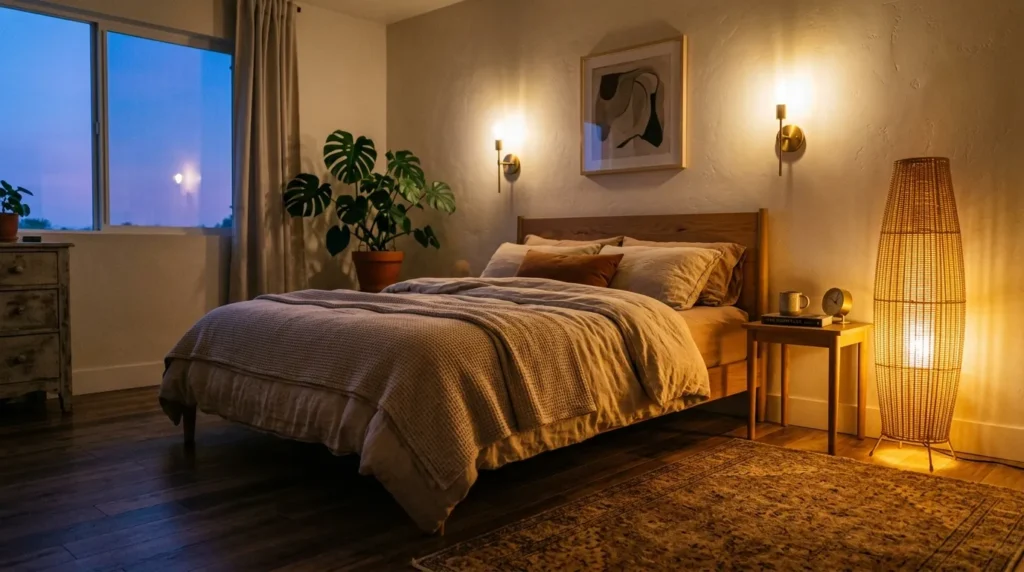
Why It Works A mistake many homeowners make is relying on a single overhead fixture to light the entire bedroom. That kind of flat, top-down light flattens everything else you’ve styled in the room — the textures, the wall treatment, the furniture silhouettes. I’ve seen this idea transform spaces almost more than any other on this list, because layered lighting does what good lighting is supposed to do: it creates mood instead of just visibility. Designers typically work with at least three light sources per room, each on a different plane, so the light feels dimensional rather than direct.
How To Style It Combine a floor lamp, a pair of table or wall-mounted sconces, and one dimmable overhead source. Choose warm bulbs (around 2700K) rather than cool white, which can feel clinical in a bedroom. Wall sconces flanking the bed free up nightstand space and add a built-in, designer feel. If your fixtures aren’t on dimmers, plug-in lamp dimmers are an easy retrofit. In the evening, turn off the overhead light entirely and let the lamps and sconces do the work — that’s usually the moment a bedroom starts to feel genuinely restful.
4. Curated Nightstand Vignettes
Quick Benefits
- Elevates a small, frequently used surface
- Adds personality without much effort
- Keeps the room feeling intentional, not cluttered
- Easy and inexpensive to refresh seasonally
- Creates a Pinterest-worthy focal detail
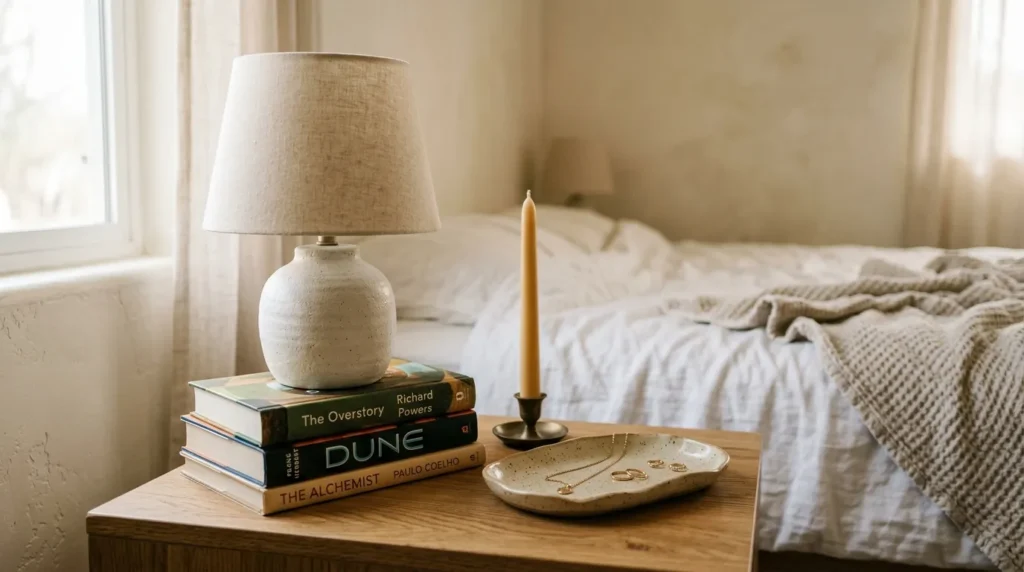
Why It Works The nightstand is one of the most-touched surfaces in the entire house, yet it’s often the most neglected visually — a charger, a random book, a half-empty water glass. That’s why many designers recommend treating it as a mini vignette rather than a functional dumping ground. A well-styled nightstand does two things at once: it stays useful, and it adds a layer of personality and polish that pulls the whole room together. It’s a small investment of effort with an outsized visual return, which is exactly why it shows up in nearly every professionally styled bedroom photo.
How To Style It Stick to a simple formula: one lamp, one small stack of books or a tray, and one organic object like a candle, a small plant, or a ceramic dish for rings and jewelry. Keep the color palette tied to the rest of the room so it doesn’t feel like a separate collection. Odd numbers of objects (three tends to work best) read as more intentional than even groupings. Clear out anything purely functional — chargers, remotes, medication — into a drawer so the surface stays visually calm.
5. Mixed Metal Accents
Quick Benefits
- Adds a collected, non-matchy-matchy feel
- Prevents the room from feeling too uniform
- Works across both modern and traditional styles
- Easy to introduce through small hardware pieces
- Adds subtle shine without feeling flashy
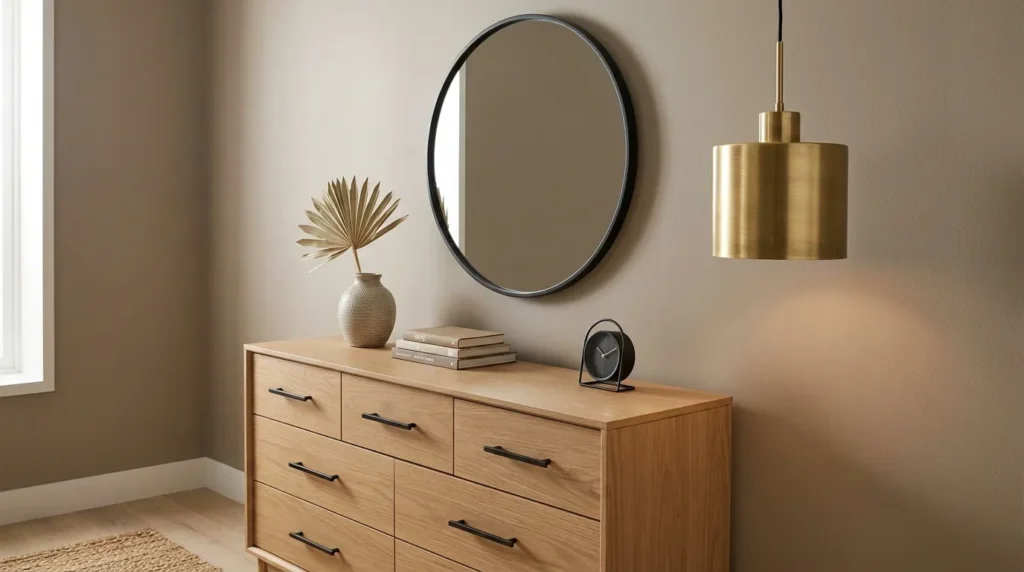
Why It Works A room where every metal finish matches perfectly — every hinge, lamp, and frame in the same brushed nickel — can actually read as less designed, not more. In my experience, mixing two (occasionally three) metal tones is what gives a space that “collected over time” look that designers are known for. Warm metals like brass or gold paired with a cooler tone like matte black or brushed steel create just enough contrast to keep the eye moving around the room without ever feeling chaotic. It’s a subtle detail, but it’s one that separates a builder-grade bedroom from a styled one.
How To Style It Choose one dominant metal (say, brushed brass for lighting and hardware) and one supporting metal (matte black for a mirror frame or bed frame) used more sparingly. Keep large fixtures — like a ceiling light — in your dominant finish, and reserve the second metal for smaller accents: picture frames, a vase, drawer pulls. Avoid using more than two metals in a small bedroom, since a third can tip the balance into visual clutter. This idea works especially well when paired with the layered neutral textures from earlier in this list.
6. Sculptural Furniture Silhouettes
Quick Benefits
- Adds visual interest without adding clutter
- Works well in smaller bedrooms
- Creates a designer, gallery-like feel
- Draws the eye without extra decor
- Pairs well with a simple, neutral palette
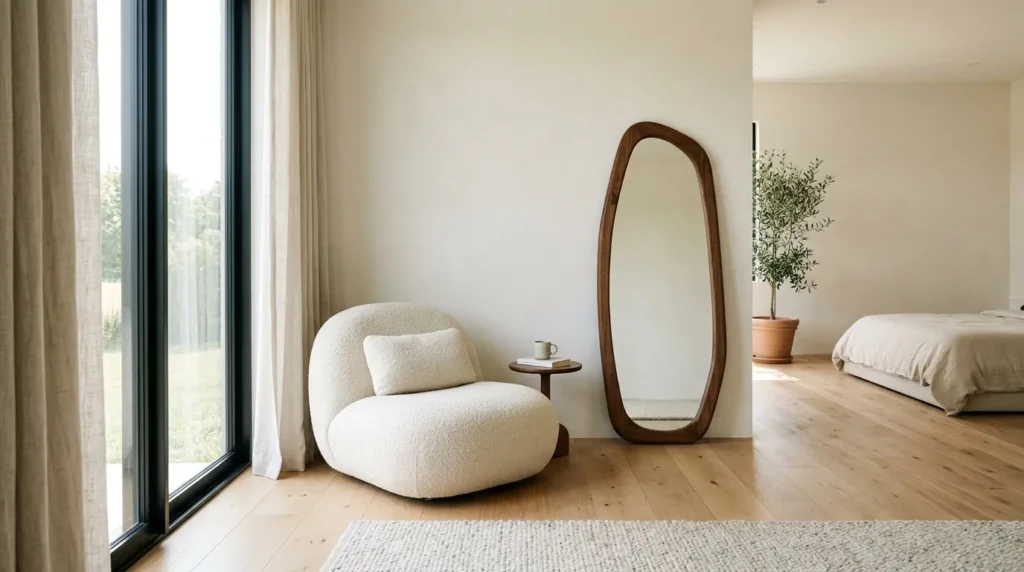
Why It Works Furniture with a curved, sculptural shape does a lot of visual work on its own — a rounded accent chair or an organically shaped mirror can carry a corner of the room without needing extra styling around it. One thing that works especially well is choosing just one or two sculptural pieces per room rather than filling every surface with shape. Straight lines and boxy furniture are easy to source but can make a bedroom feel generic. A single curved silhouette breaks up all those right angles and gives the space a more custom, gallery-inspired feel.
How To Style It Look for one statement piece — a curved bench at the foot of the bed, an organically shaped accent chair, or a sculptural floor mirror — and let it stand mostly on its own. Keep the surrounding furniture simpler and more streamlined so the sculptural piece doesn’t have to compete for attention. Wood tones like walnut or oak tend to photograph especially well in this style, and a bouclé or velvet upholstery adds softness to the curve. Resist the urge to add more than one or two of these pieces in a single room.
7. Soft Color Layering
Quick Benefits
- Creates depth without harsh contrast
- Feels calming and restful, ideal for bedrooms
- Easier to live with long-term than bold color
- Works well with natural light throughout the day
- Complements both modern and traditional furniture
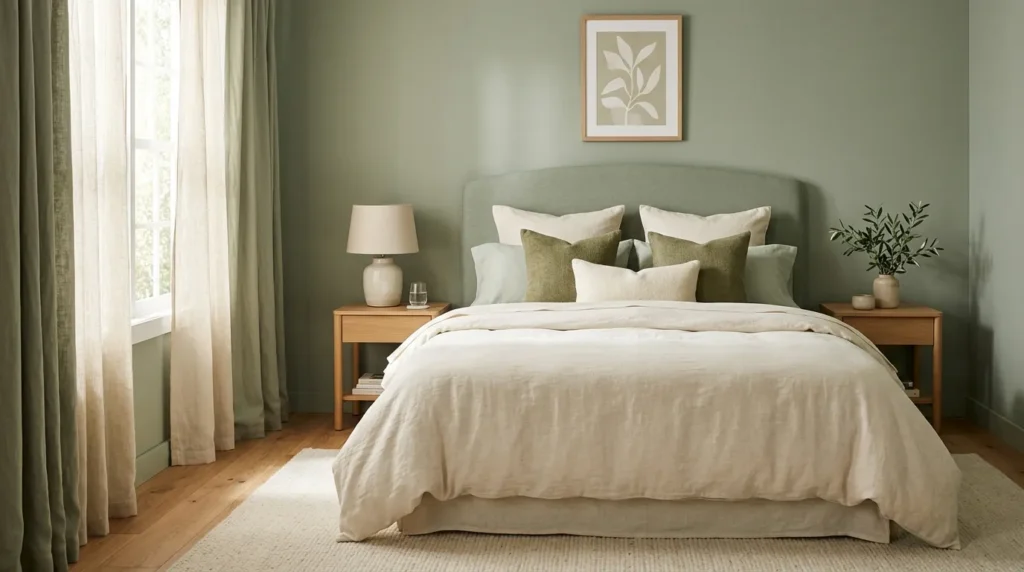
Why It Works Bold, high-contrast color schemes can look striking in a photo but tend to feel overwhelming to actually sleep in night after night. I’ve noticed that the most restful modern bedrooms use tonal color layering instead — two or three shades within the same color family, like sage, moss, and cream, or dusty blue, slate, and off-white. This approach gives the room depth and a sense of intention without ever feeling loud. It also tends to age better over time, since soft tonal palettes rarely feel dated the way a single trendy accent color can.
How To Style It Choose one anchor tone for the walls or bedding, then pull two supporting shades from the same family for accents — a throw pillow, a rug, a piece of art. Keep true neutrals (white, cream, warm gray) as your connective tissue between the tones so nothing feels disjointed. Natural light changes how these colors read throughout the day, so it’s worth testing paint swatches in the room at different times before committing. This idea pairs especially well with the layered textures and mixed metals covered earlier in this guide.
8. Textured Wall Treatments
Quick Benefits
- Adds architectural interest beyond paint
- Works as a full-room or single-wall treatment
- Increases perceived value of the space
- Available in budget-friendly peel-and-stick options
- Creates a strong backdrop for furniture and art
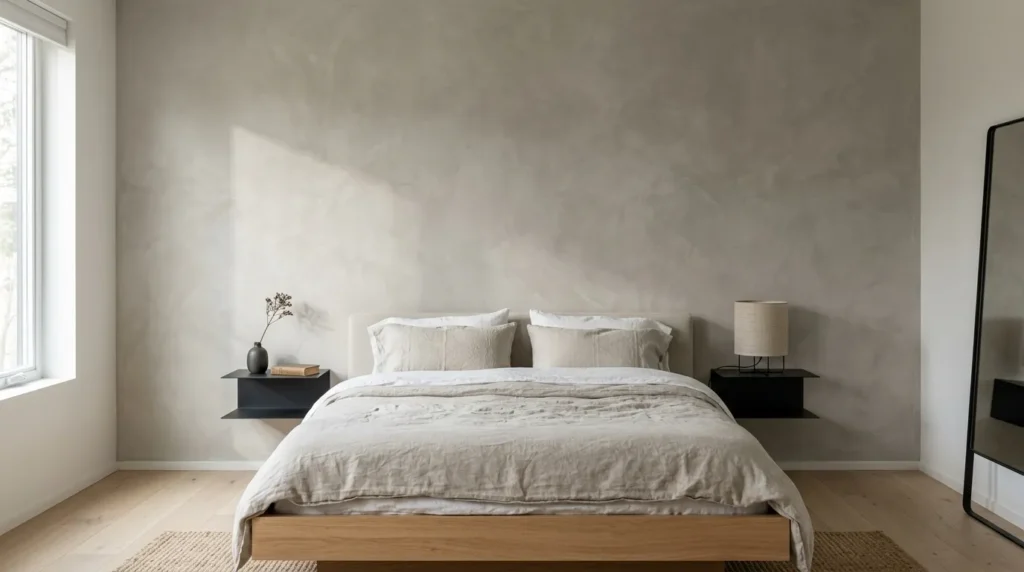
Why It Works Flat painted drywall is functional, but it rarely reads as “designed.” A mistake many homeowners make is assuming texture requires a full renovation, when in reality there are accessible ways to bring in dimension. Limewash paint, wood paneling, textured plaster, or grasscloth wallpaper all add a tactile quality that flat paint simply can’t replicate. This is one of those ideas that tends to show up again and again in designer portfolios because it does so much with so little — a textured wall alone can carry an entire room’s design story.
How To Style It For a lower-commitment option, try a limewash paint effect (there are approachable DIY kits) or a textured grasscloth wallpaper on one wall. For a slightly bigger project, tongue-and-groove or shiplap paneling painted in a warm neutral adds real dimension and works beautifully behind a bed or along an accent wall. Keep the rest of the walls smooth and simple so the textured wall remains the focal point. Pair it with matte, low-sheen furniture finishes so the texture of the wall doesn’t have to compete with shiny surfaces nearby.
9. Minimalist Gallery Display
Quick Benefits
- Adds personality without visual clutter
- Easy to update as your taste evolves
- Works in small or large wall spaces
- Creates a curated, intentional feel
- Inexpensive compared to large statement art
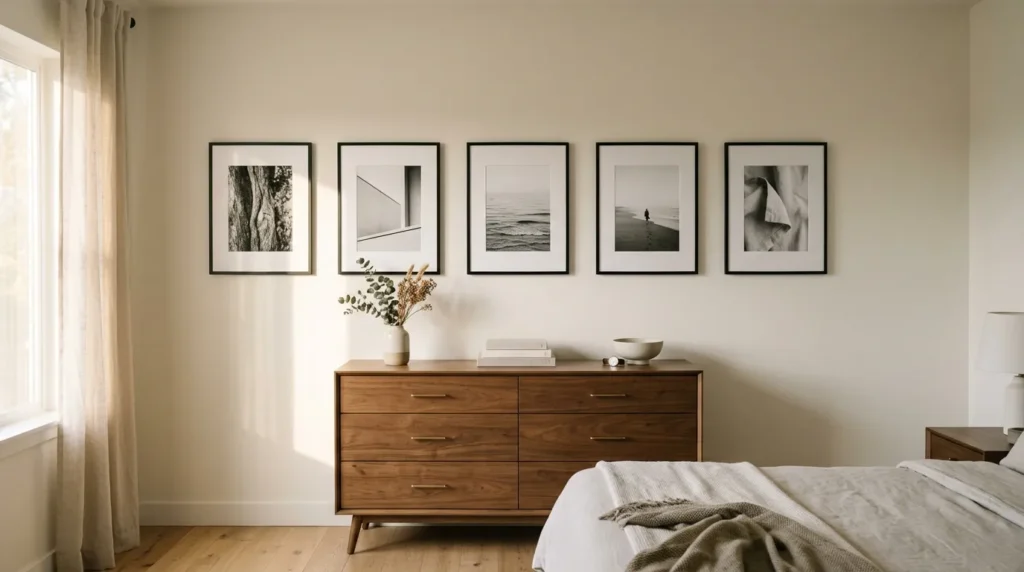
Why It Works A wall covered edge-to-edge with mismatched frames can quickly tip from “curated” into “cluttered.” One simple trick I always suggest is embracing negative space just as much as the art itself — a gallery of three to five pieces, generously spaced, tends to read as far more intentional than a dense cluster of ten. This is a technique borrowed directly from actual art galleries, where empty wall space is treated as part of the composition, not wasted real estate. It’s a small mindset shift that makes a noticeable difference in how “finished” a bedroom feels.
How To Style It Choose three to five pieces in a cohesive color story — black-and-white photography, warm abstract prints, or a mix of textural pieces like a woven wall hanging alongside framed art. Vary the sizes slightly but keep frame finishes consistent (all black, all natural wood, or all a mix of two tones) for cohesion. Leave at least six inches of breathing room between each piece. A single oversized piece of art can also work beautifully in place of a full gallery if you prefer an even more minimal approach.
10. Cozy Reading Corner
Quick Benefits
- Adds function beyond just sleeping
- Creates a dedicated wind-down space
- Works even in smaller bedrooms
- Encourages screen-free relaxation time
- Adds a layered, lived-in design element
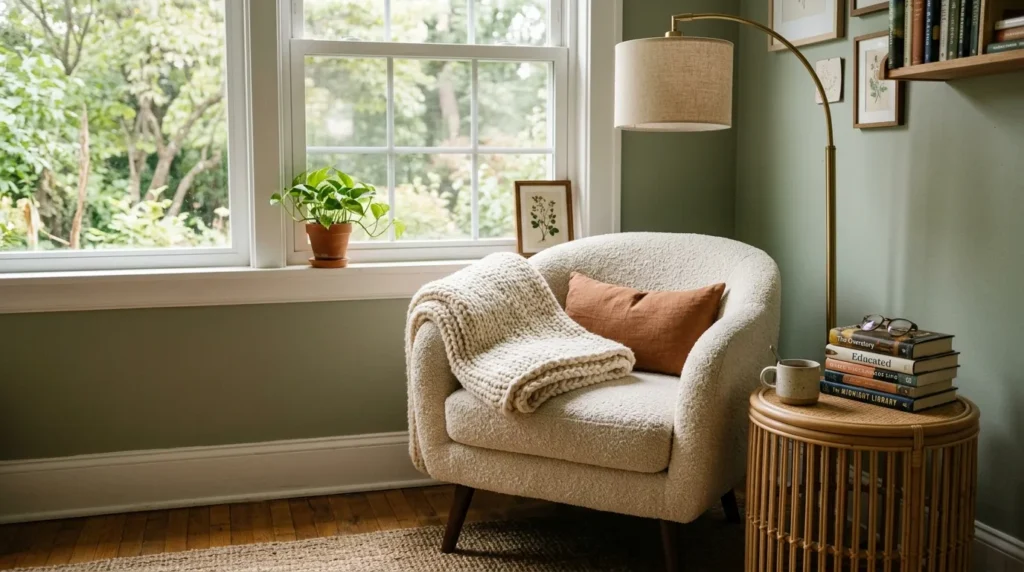
Why It Works If you’re anything like me, the bedroom is the one room where you actually want to slow down at the end of the day — and a small reading corner supports that in a way the bed alone can’t. A dedicated nook, even a modest one, gives the room a second purpose and a second area to style, which adds depth to the overall design. Designers often tuck these into an underused corner or beneath a window, taking advantage of natural light during the day and creating a warm, lamp-lit retreat in the evening.
How To Style It Look for an unused corner, a spot beneath a window, or the foot of the bed if space allows. A single accent chair or a small bench, a floor lamp, a side table, and a soft throw are really all you need. Layer in a small stack of books and a plant if there’s room. Keep the chair’s upholstery tied to the room’s existing color palette so the corner feels like an extension of the bedroom rather than a separate zone. Even a three-foot-wide corner is enough space to make this idea work.
Frequently Asked Questions
What makes a bedroom feel “modern” without feeling cold? Modern doesn’t have to mean stark or minimal. Warm modern bedrooms lean on natural materials — wood, linen, wool — layered textures, and soft ambient lighting rather than harsh overheads. Sticking to a tonal color palette with a few organic shapes keeps the look current while still feeling comfortable and lived-in rather than sterile.
How many colors should a modern bedroom palette include? Most designer bedrooms work within two to three tones from the same color family, plus a neutral base like white, cream, or warm gray. This keeps the space feeling cohesive and restful rather than busy. You can always add seasonal accent color through pillows or throws without repainting.
Do I need to renovate to get a designer look? Not at all. Many of the ideas in this guide — layered textures, nightstand styling, lighting changes, gallery walls — can be done in a weekend with no construction required. Renovation-level ideas like paneling or plaster are optional upgrades, not requirements, for a room to feel intentionally designed.
What’s the biggest mistake people make when decorating a bedroom? Relying on a single overhead light source is one of the most common issues. It flattens the whole room and makes even well-chosen furniture and decor look less polished. Adding at least two additional light sources, like a lamp and sconces, makes an immediate difference.
How do I choose art for a bedroom gallery wall? Pick pieces that share a common thread, whether that’s color palette, subject matter, or frame finish, so the grouping feels curated rather than random. Leave generous space between each piece, and don’t be afraid to use fewer, larger pieces instead of many small ones.
Is it okay to mix metal finishes in one bedroom? Yes, and it’s actually a technique many designers use intentionally. Pairing a dominant metal finish with one supporting tone — like brass lighting with black hardware — adds a collected, designer feel. The key is limiting it to two finishes so the room doesn’t feel scattered.
What’s an easy way to start updating my bedroom this weekend? Start with lighting and your nightstand styling — both ideas from this guide that require no major purchases or construction. Swapping in warm bulbs, adding a lamp, and editing down your nightstand to a few intentional objects can shift the whole feel of the room in an afternoon.
Bringing It All Together
A modern bedroom doesn’t come together all at once, and it doesn’t need to. Every idea in this guide can stand on its own, which means you don’t have to overhaul the entire room this weekend to see a difference. Start with one or two ideas that feel most doable right now — maybe it’s swapping your lighting, editing your nightstand, or adding a single sculptural chair — and build from there as your budget and time allow.
What ties all ten of these ideas together is intention. A designer-inspired bedroom isn’t about spending the most money; it’s about making deliberate choices instead of default ones, whether that’s choosing warm bulbs over cool ones or leaving breathing room around your gallery wall instead of filling every inch. Small, consistent choices compound into a room that feels genuinely restful and put-together.
Start with one or two ideas and gradually build a space that reflects your style and supports everyday comfort. Save this guide so you can come back to it as you work through each idea, and feel free to mix and match rather than following the list in order — the best bedrooms are the ones that feel like they belong to the person sleeping in them.
Related Articles
- Cozy Bedroom Ideas for Small Spaces
- Neutral Home Styling Tips
- DIY Accent Wall Ideas on a Budget
- Modern Farmhouse Bedroom Inspiration
- Small Bedroom Layout Solutions